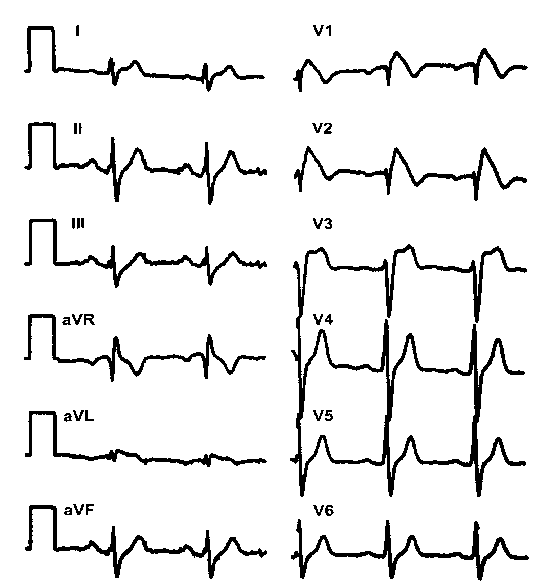
V1 leads in Brugada syndrome (left) and ARVC (right)
Today we discussed syncope. For a discussion of an approach to syncope with a link to an excellent review from Circulation, click here
The topics of the Brugada syndrome and arrhythmogenic right ventricular cardiomyopathy -ARVC (aka ARVD, d for 'dysplasia') came up. A few points on these rare, but important causes of syncope:
Brugada syndrome:
Brugada syndrome:
Characterized by "pseudo-RBBB", with ST elevation in R precordial leads and high incidence of sudden death in patients with structurally normal hearts (up to 4% of all sudden deaths, 20% of cases with structurally normal heart). Typically presents in adulthood.
Prevalence is unknown; estimated to be 5/10,000 but may be as high as 50/10000 in Asian populations.
May be associated with either atrial or ventricular arrhythmias.
Diagnosis:
Classic ("type 1") ECG is "coved" ST eleation over 2mm in one or more of V1-V3 with T-inversion (shown above).
Prevalence is unknown; estimated to be 5/10,000 but may be as high as 50/10000 in Asian populations.
May be associated with either atrial or ventricular arrhythmias.
Diagnosis:
Classic ("type 1") ECG is "coved" ST eleation over 2mm in one or more of V1-V3 with T-inversion (shown above).
There are less classic ECG changes in Brugada syndrome, including "saddlebacked" ST elevation in same leads.
Many other conditions can mimic the R-sided ST changes seen in Brugada syndrome, including RBBB, LVH, early repolarization, MI, PE, hyperkalemia, ARVD, hypothermia, and Duchenne's muscular dystrophy.
The use of a sodium channel blocker like procainamide can bring out the ECG changes, and this type of "challenge" can be helpful diagnostically (obviously needs to be done in appropriate setting...)
Therapy may consist of antiarrhythmic therapy (quinidine) or implantation of a defibrillator (ICD). General indications for an ICD include aborted arrest, inducible VT on EP study, and suggestive ECG with otherwise unexplained syncope or family history.
ARVC:
Many other conditions can mimic the R-sided ST changes seen in Brugada syndrome, including RBBB, LVH, early repolarization, MI, PE, hyperkalemia, ARVD, hypothermia, and Duchenne's muscular dystrophy.
The use of a sodium channel blocker like procainamide can bring out the ECG changes, and this type of "challenge" can be helpful diagnostically (obviously needs to be done in appropriate setting...)
Therapy may consist of antiarrhythmic therapy (quinidine) or implantation of a defibrillator (ICD). General indications for an ICD include aborted arrest, inducible VT on EP study, and suggestive ECG with otherwise unexplained syncope or family history.
ARVC:
This is a genetic condition (autosomal dominant with variable penetrance) characterized by progressive replacement of RV myocardium with fibro-fatty infiltration, which predisposes to ventricular arrhythmia.
Prevalance is estimated to be 1-5 per 1000; highest prevalence in southern European populations (especially Italian). Typically presents from teens to 30s, and affects more males than females.
Prevalance is estimated to be 1-5 per 1000; highest prevalence in southern European populations (especially Italian). Typically presents from teens to 30s, and affects more males than females.
Diagnosis should be considered in adolescents or young adults presenting with palpitations, syncope, or aborted sudden death. ECG may show T-inversion in R precordial leads (shown above), possibly with "epsilon wave"- small "saddle" in ST segment in V1-V3.
Imaging modalities sigh as 2D echo (most commonly used) and cardiac MRI (becoming more common) may show RV structural changes, and are part of the diagnostic criteria. Family members should be screened.
Therapy:
ICD is indicated for similar indications to above for Brugada syndrome (aborted sudden death, inducible VT).
There is a role for pharmacologic therapy (B-blocker like sotalol antiarrhythmic like amiodarone) in supprssing arrhythmias.
Participation in sports increases the risk of sudden death 5-fold; 24 years of a screening programs in Italy has led to a significant decline in sudden death in athletes.
There is no well-validated risk stratification tool to assess which patients are most likely to benefit from which therapies.
Links:
Click here for a 2005 review from Circulation on Brugada syndrome
Click here for a 2009 review from Lancet on ARVC
Click here for a JAMA paper showing the mortality reduction in Italy from screening for ARVC in competitive athletes